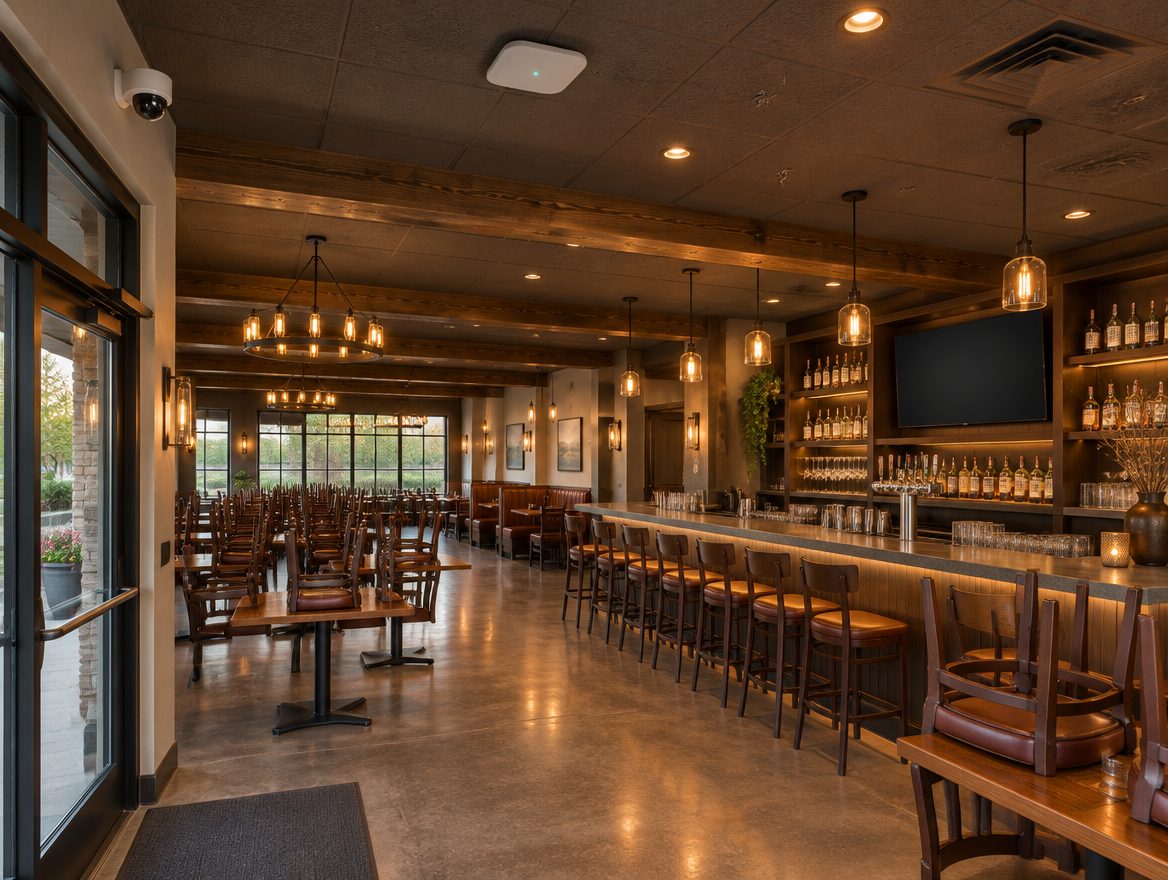
Opening, moving or refitting a restaurant in Los Angeles means a long list of trades, and the low-voltage layer tends to fall between them. ClearMax technicians take that layer as one job: a tested data run to every terminal, ticket printer and line screen, access points sized for the patio and the bar, a locked rack holding switch and firewall, badge readers at back-of-house doors, cameras watching the drawers, and menu screens. It is drawn with the general contractor and finished before the POS company sets up.
Last updated: November 2026
- 1Count the devices. Registers, receipt and ticket printers, delivery tablets, handhelds, displays, readers and cameras each get a mark on the plan and a row on one list.
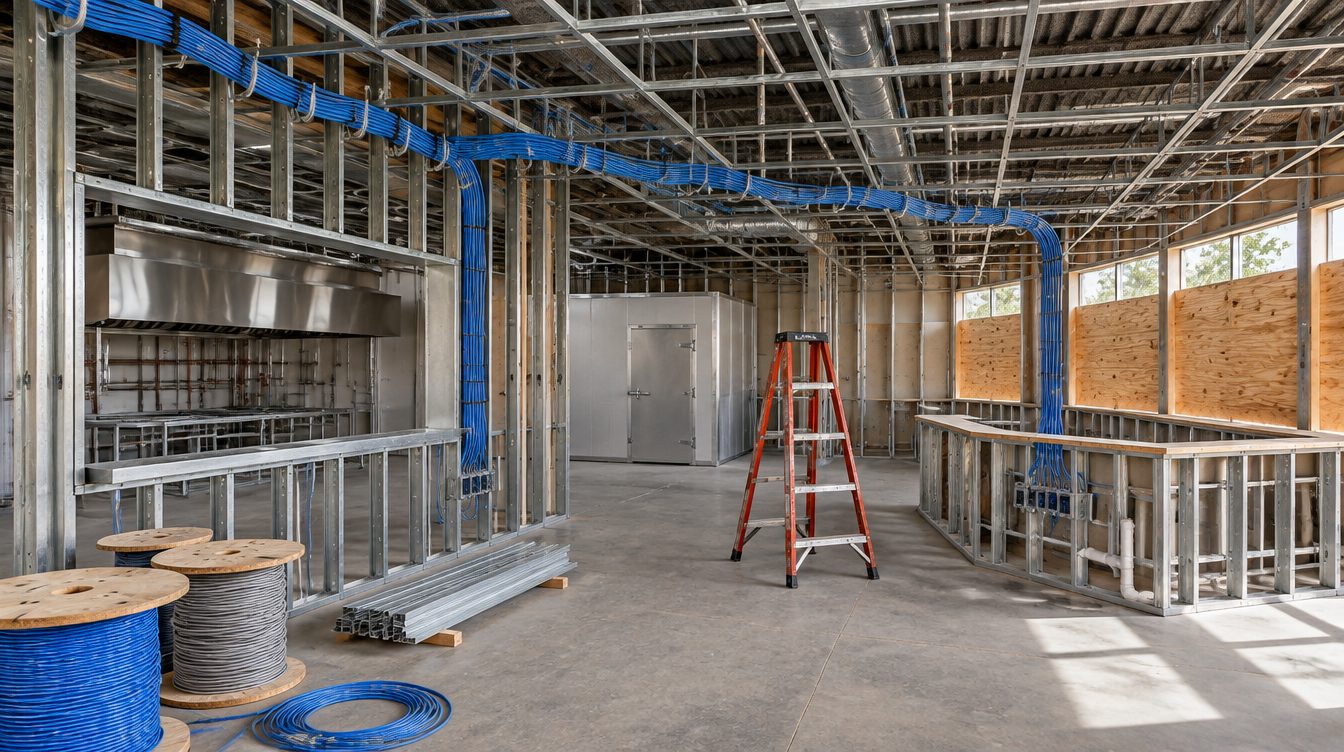
- 2Pull cable while the framing is bare. Data, door wiring and the rack circuit go in at rough-in, on the builder's calendar, with the LADBS permit in hand.
- 3Test, label, hand over. Each run is tested and printed out, the payment network carries traffic, and the owner keeps the drawings.
The register company expects a finished room
On install day a POS technician mounts terminals, loads the menu and walks the staff through a first shift. They are not there to pull wire. Toast's own site readiness guide, as one example, says Toast does not run networking cables. That guide also says Toast will not install if the location is in active construction. A missing drop pushes the visit back, so cable and the rack land first.
What sits inside the low-voltage scope
- Data cable and WiFi: one home run per register, receipt or ticket printer and display, with ceiling access points covering tables, bar and patio.
- A network just for payments: Toast recommends physically segmenting the network from other outside traffic, so the guest WiFi, the delivery tablets and the manager's laptop each ride a lane of their own.
- Cameras: entry, registers, bar, storage and the delivery door, recorded on a box in the rack.
- Badge readers: the rear exit, the office, the wine or liquor room, matched to the exit rules that follow.
- Screens: menu boards over the counter and displays down the line.
Door hardware under the California Building Code
California adopts its own building code, Title 24, and its egress chapter sets what hardware an exit from the dining room may hold. Section 1010.2.8 says swinging doors serving rooms or spaces with an occupant load of 50 or more in a Group A or E occupancy shall not be provided with a latch or lock other than panic hardware or fire exit hardware. The main exit has an exception, covered next. Section 1010.2.8.3 wants panic bars listed to UL 305, with the actuating portion extending not less than one-half of the door leaf width, and a maximum unlatching force that shall not exceed 15 pounds. The posted occupant load is the number that decides which doors this reaches.
The front entrance gets different treatment. Section 1010.2.4 lists the cases where locks and latches may prevent a door from opening. Under item 3, the main door of a Group A space with an occupant load of 300 or less may have a key-operated lock from the egress side, provided that all four conditions hold: the doors are the main exterior doors to the building or the main doors to the tenant space; the locking device is readily distinguishable as locked; a sign reading THIS DOOR TO REMAIN UNLOCKED WHEN THIS SPACE IS OCCUPIED is posted; and the use of the key-operated lock is revocable by the building official for due cause. That lock is for closing time, not for service.
A reader with an electric lock adds two more conditions:
- Section 1010.2.10 says loss of power to the electrical locking system automatically unlocks the electric lock, and that operating required panic hardware also releases the electric lock.
- Section 1010.2.11, for sensor release, wants a manual unlocking device 40 inches to 48 inches above the floor and within 5 feet of the secured doors, signed PUSH TO EXIT, with the lock to remain unlocked for not less than 30 seconds once pressed.
So every door with a reader appears on a door schedule: the load it serves, the hardware, how it releases, and where its lock power comes from. The locks run on their own supply and drop open when it goes.
Menu boards, kitchen displays and delivery tablets
Each menu board wants a data jack and an outlet behind its mount before the wall is skimmed. Kitchen displays get a cable instead of WiFi, so tickets keep flowing on a full night. Delivery-app tablets get a drop and a shelf near the pass.
The rack, seismic bracing and the back office
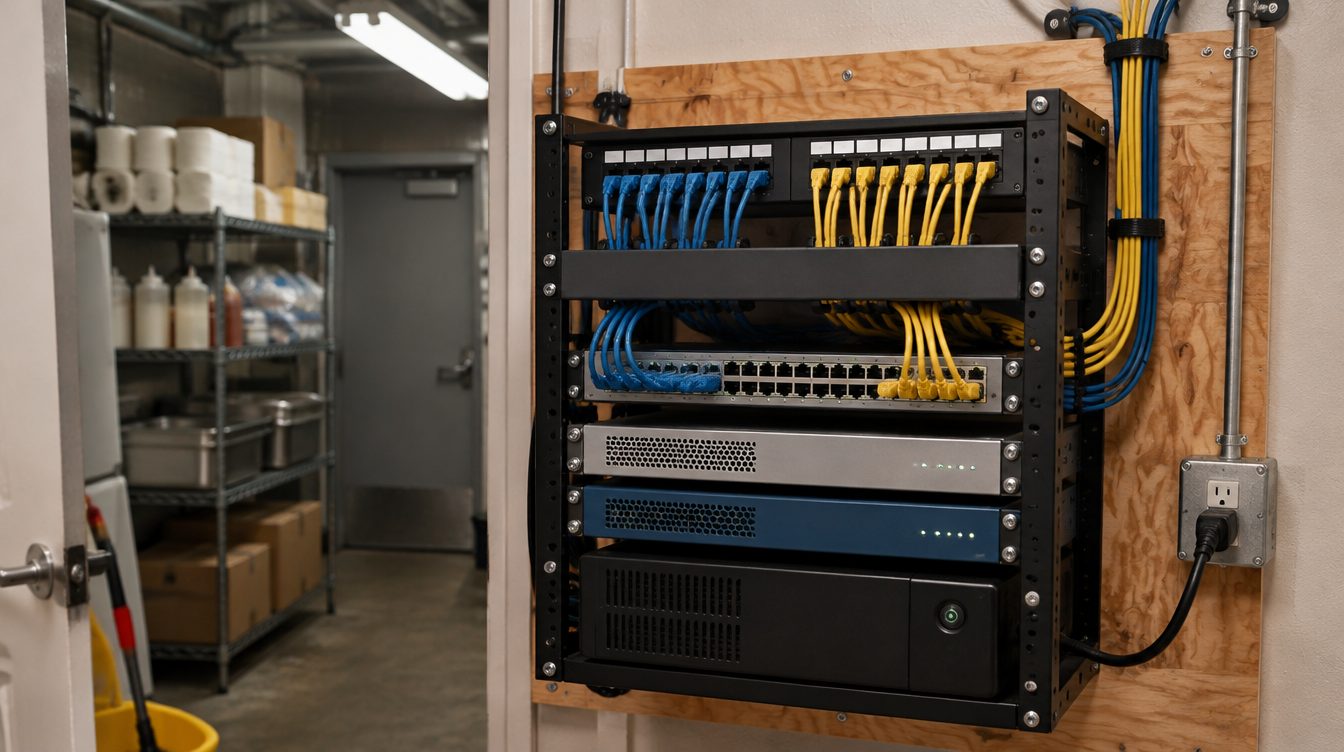
Every run lands in one locked closet or wall cabinet: patch panel, switch, firewall, the NVR and a compact UPS. The cabinet is anchored to the structure, since a rack that tips in a tremor takes the registers down with it, and it sits away from the dish pit, the fry station and the cooler compressor. Every login, internet account and camera app belongs to the restaurant from day one.
Once doors open, drawings and port records stay with the owner, and a managed IT plan adds monitoring and cybersecurity for those who want ongoing help.
Card numbers and California's privacy statutes
Payments taken at the counter bring state law into the room. Civil Code Section 1798.82 counts a person's first name or first initial and last name, in combination with an account number or credit or debit card number and any required security code, access code or password, as personal information when either the name or the card data is not encrypted. Section 1798.81.5(b) says a business holding personal information about a California resident shall implement and maintain reasonable security procedures and practices appropriate to the nature of the information.
The breach rules set a clock. For a business that owns or licenses computerized data that includes personal information, Section 1798.82(a)(2)(A) says the disclosure shall be made within 30 calendar days of discovery or notification of the data breach, subject to subparagraph (B), which lets the business delay it to accommodate the legitimate needs of law enforcement or as necessary to determine the scope of the breach and restore the reasonable integrity of the data system. Section 1798.82(f) adds that a notice going to more than 500 California residents from a single breach means a sample copy is submitted electronically to the state’s chief legal officer. A payment lane of its own, plus switch, door and camera logs that can still be read later, gives an owner a way to answer inside that window. None of this is legal advice; a restaurant's duties are for its own counsel.
Questions LA owners bring to the first call
How early does the cabling plan start?
As soon as the cook line and seat count are fixed. A jack moved on paper is free; after plaster, it means a cut wall.
What goes into the quote?
A floor plan, a device count, the opening target and the doors getting readers. Should the work outgrow those details, the change is raised and the bid revised before anything extra begins.