
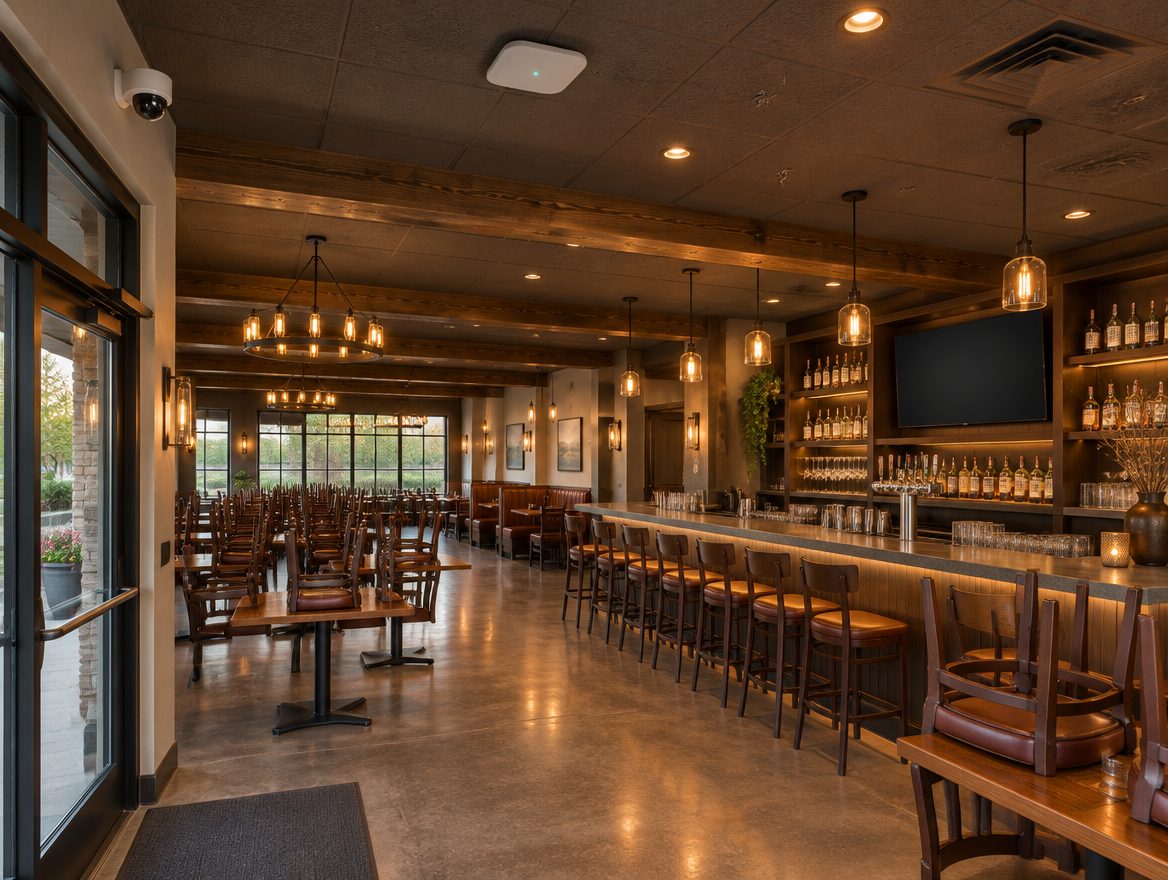
Low voltage wiring in a Los Angeles restaurant is the part of the build that nobody sees once the ceiling tiles go back. It is also the part that decides whether the registers, kitchen printers and handhelds work on opening night. ClearMax technicians plan it from the device count, pull it at rough-in, and hand over every run tested and labeled.
Last updated: November 2026
Starting from the device count
Before a single box of cable is opened, the plan lists every device that needs a wire and where it lives:
- Each register and card reader at the counter, the bar and the host stand.
- Receipt printers out front and ticket printers at each kitchen station.
- Kitchen display screens on the line and at expo.
- Delivery-app tablets and their charging spot.
- Ceiling access points, menu boards, cameras and door readers.
- The office computer, the phone handset and a couple of spares.
Every item becomes a numbered jack on the drawing. Spare drops are added where a second register or a new screen tends to appear within a year.
Specs taken from a POS vendor's own pages
The register company publishes its requirements, and the cable is built to meet them before its technician arrives. One register company's guide is the example used here:
- Toast's guide says Toast will not complete the install if the Ethernet cables are less than 100MB (Cat5e). Runs here are Cat6 or better.
- The guide says terminal cable drops must be terminated with an RJ45 female jack to the T568B wiring scheme. Each one is, with a coil of slack left above the ceiling.
- It also says a 15 Mbps download speed is the minimum to use the system. The internet line and firewall are set so the registers keep their share during a rush.
- Toast recommends physically segmenting the network from other outside traffic/network communications. The payment devices get a network or VLAN of their own.
WiFi for the dining room, the bar and the patio
Outdoor seating is a fixture of dining in this city, and it is where a handheld usually drops its signal first. Toast's requirements say all wireless communications should be set to operate on the 5Ghz band. Access points are placed for 5 GHz coverage at every table, including the far corner of the patio, with a weatherproof unit outside when the walls block too much. Guest WiFi broadcasts on its own name and stays off the payment network entirely.
LADBS permits for voice and data work
Inside the City of Los Angeles, the Department of Building and Safety treats this as permitted work. LADBS says Electrical Permits are required for any electrical work. For most cabling jobs the path is short: its express permit bulletin, whose permits apply only to non-engineered wiring, lists New Telephone and computer wiring - voice and data as work that needs no plan check.
Larger dining rooms can change the track. LADBS says electrical plans shall be filed with and approved by the Department, as an Electrical Plan Check, before a permit is issued for work related to places of assembly, among other building types. When a room falls in that group, plan check goes on the schedule early instead of surprising everyone in week six. The scope names any City permit the job needs and schedules it. Restaurants in other cities across the county answer to their own building departments, and the plan follows theirs.
Proof that each run works
Every cable is tested end to end with a cable tester, and the results are saved for the owner. Both ends carry the same label, the patch panel matches the drawing, and the switch ports are mapped to the device they serve. The marked-up plan, the test results and the port map go into the closing file.
Pulling cable in a working kitchen
Refits rarely get an empty building. Pulls above the line are scheduled before prep or on the closed day, ceiling tiles are covered against grease, and cable paths stay clear of the hood, the fryers and anything that runs hot. Nothing is left hanging over a prep table at the end of a shift.
Common questions about the wiring
Can existing cable be reused?
Sometimes. Old runs are tested first; those that pass, and that land where the new plan needs them, stay. The rest are pulled out rather than abandoned in the ceiling.
Does the rack need its own circuit?
Usually, and the electrician adds it. The scope lists the circuit so it is in the electrical plan from the start.
The buildout overview covers door readers and screens, and the camera page covers the recorder these runs feed.